

The founder of LinkedIn is betting over tens of millions of dollars on AI jewelry. Will this be the future development trend of the industry?

When I met Mariam Naficy last week, she couldn't wait to show me her new jewelry. She designed the earrings she was wearing, as well as her bracelet and, for safety's sake, her ring.
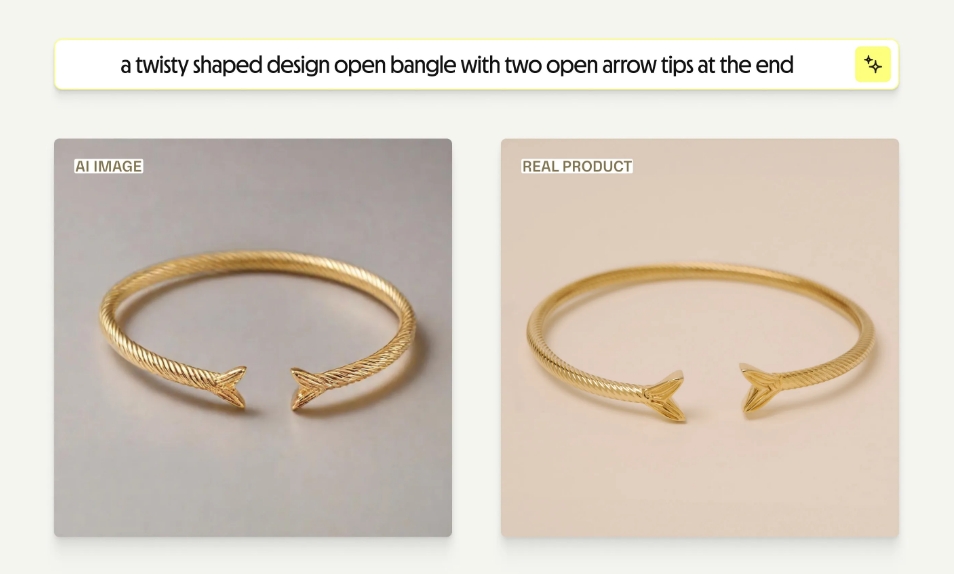
Technically, Naficy — whose keen eye for e-commerce trends led her to start early online cosmetics retailer Eve.com and Minted, which makes custom holiday cards and wedding invitations — has a little help in her accessory creations. They’re the product of her startup Arcade, a new site that lets shoppers design their own jewelry by typing a few simple words — like gold teardrop earrings — into an AI-powered tool.
Once a customer is happy with their design, Arcade will send a digital model of the jewelry to an artisan, usually in a place like India or Italy that is full of artisans. The artisan will produce the design and ship the finished product to the customer within two to three weeks.
The site, which officially launches today, aims to prove that artificial intelligence can spawn a new form of online commerce, where consumers can design nearly any product they can imagine, even if they don’t have the imagination or skills to create it. If successful, Arcade’s approach could also show how merchants can mitigate the challenges of predicting consumer trends and changing tastes, and the risks of unsold inventory that come with it.
Naficy’s vision has attracted the attention of Silicon Valley heavyweights, including venture capitalist and LinkedIn co-founder Reid Hoffman, who invested $17 million in the company. The funding has not been previously reported.
Hoffman and Naficy had known each other for years through “Zero Wheel,” a dinner series for founders and entrepreneurs in the Bay Area in the early 2000s. When Naficy first mentioned the rough concept of what would become “Arcade” to him, he didn’t beat around the bush.
“Drop everything else and do this,” Hoffman said he told her.

Jewelry is just the beginning, and Naficy hopes that eventually Arcade will be able to apply the same process to a wide range of categories, which could include home decor and other accessories.
Retailers and brands have used similar strategies in the past. Nike, for example, has long allowed customers to customize their sneaker designs. Meanwhile, startups like Daydream and tech giants like Google have also tried combining artificial intelligence with e-commerce to help customers find the perfect product.
Naficy said these approaches limit the technology’s capabilities. Instead of just selecting options from a preset list of colors and designs, shoppers using Arcade’s AI have more creative possibilities — whether it’s a necklace with an inside joke image or a bracelet that roughly replicates a lost family heirloom (shoppers can submit photos of jewelry to inspire Arcade but can’t request an exact copy).
“I think now we can really shift the power to consumers, rather than manufacturers,” she said. “So who gets to decide what gets produced? This can really become a consumer-led proposition.”
Naficy, 54, developed a passion for shopping early. The daughter of UN and USAID researchers, she moved around North Africa and the Middle East as she grew up, eventually settling in Bethesda, Maryland, as a teenager. Along the way, she fed her retail habit by rummaging through dusty bazaars with her mother and visiting malls with high school friends.
Under pressure from her pragmatic mother, Nafisi became a “helpless” economics major at Williams College, which she says transformed into an investment banking analyst at Goldman Sachs after graduation. But it wasn’t until she graduated from Stanford University’s Graduate School of Business in 1998 that she saw a way to combine her childhood love of shopping with a career.
At the time, e-commerce was still in its early stages and Amazon had yet to fully shed its identity as an online bookstore and transform into an all-purpose store. Nafisi and her friend Varsha Rao from their investment banking days saw an opportunity to bring a new category to the online market.

At the time, the U.S. beauty industry was a far cry from the modern duopoly that dominates cosmetics sales: Sephora and Ulta. Most cosmetics were sold in department stores. For smaller brands, keeping stores stocked and the fees retailers charged for listing were mostly unaffordable.
With Eve.com, Naficy and Rao hoped to make those brands more accessible to consumers. The idea was so successful that the duo sold it to startup incubator Idealab in 2000 for $110 million in cash, just two years after its launch—lucky timing considering the dot-com bubble would soon burst. (Idealab ultimately shut down the site later that year and sold some of its assets to Bernard Arnault’s luxury goods conglomerate LVMH.)
A few years later, Naficy saw an opportunity to make it easier for small artists to reach shoppers online, while also giving those shoppers a greater say in what was available.
In 2007, she began pitching venture capital firms the idea for Minted, an e-commerce site that would sell stationery, greeting cards and wedding invitations based on crowdsourced designs from consumer votes. Hill Road’s investors scoffed at the idea, so Naficy decided to also sell goods from other, more established brands.
Initially, the idea flopped. When Minted launched the following year, “nothing sold,” said Melissa King, Minted’s co-founder and current CEO. “We launched with absolutely no reaction.”
Still, the few sales Minted has made come from products designed by artists the company recruited through crowdsourcing competitions — Naficy’s original idea for the startup. “We don’t typically recruit artists from traditional design hubs — not a lot of people from New York, Los Angeles, Paris,” King said.
As sales of wedding invitations and holiday cards designed through Minted contests rose, the business expanded into wall art, calendars, notebooks and other categories. It struck deals with big retailers such as West Elm to sell products with Minted designs.
Eventually, Naficy realized she didn’t want to be CEO forever. As Minted continued to grow, Kim gradually took on more responsibilities, and in 2013, she took on the role of president, which Naficy said at the time was intended to groom Kim to be her successor so that she could eventually step down from the CEO role.
"Mariam did start to feel unhappy in the job for a while — she loved going from zero to one, she loved building, she loved the fast pace of change. She didn't like scaling, she didn't like classic management and all that stuff," King said.
Soon after, the Covid-19 pandemic canceled in-person events and caused shoppers to temporarily stop many purchases—bad news for a company like Minted, which relies on weddings, birthday parties, and other gatherings. In early April 2020, the company laid off 147 employees, about 40% of Minted’s workforce.
“When we were all hesitating and worried about what was going to happen with Covid and how drastic action we would need to take, [Nacify] was well in advance and made it clear that we needed to take pretty drastic action for the survival of the company,” King said.
In 2022, Naficy stepped back from the day-to-day management of Minted entirely, becoming executive chairperson. As she considered what to do next, Naficy kept thinking about taking the concept behind Minted a step further.
She wondered what would happen if a startup gave shoppers the tools to create their own products, even if they couldn’t draw a design to send to a jewelry maker or didn’t know where to look for creative inspiration.
“We’ve been thinking about how AI is going to break down supply chains because it gives individuals the ability to code, the ability to write — the ability to do all of these things,” she said.
She singled out jewelry as a key starting point. It was a logical entry point, a category that lends itself easily to personalized products. An added bonus: Jewelry has relatively high profit margins (Danish jewelry retailer Pandora had a gross margin of more than 78% last year).
But Naficy said it’s also challenging to build an AI model that covers all the possible variables in jewelry making. She hopes addressing the complexity of jewelry making will make it easier for Arcade to expand its AI tools to simpler categories in the future.
“There are so many different metals, and there are enamels and resins, and there are gemstones, and there are diamonds, and there are chains,” said investor Brit Morin, who co-led Arcade’s first funding round with Hoffman.
Arcade’s AI tools use large language models from OpenAI and Google, as well as image generators from Flux and Stable Diffusion, combined with internal models trained on jewelry images, technical terms for specific jewelry components, and other data provided by artisans Arcade works with.
“Drop everything else and do this.”
The company combines these with a pricing formula to determine the final retail price based on materials and rates negotiated with artisans.
Arcade is designed to cater to a wide range of customers, from those looking for low-priced trinkets to those seeking luxury engagement rings. Arcade’s prices are based on the complexity of the jewelry, which determines the amount of labor required to create it, as well as the cost of the materials.
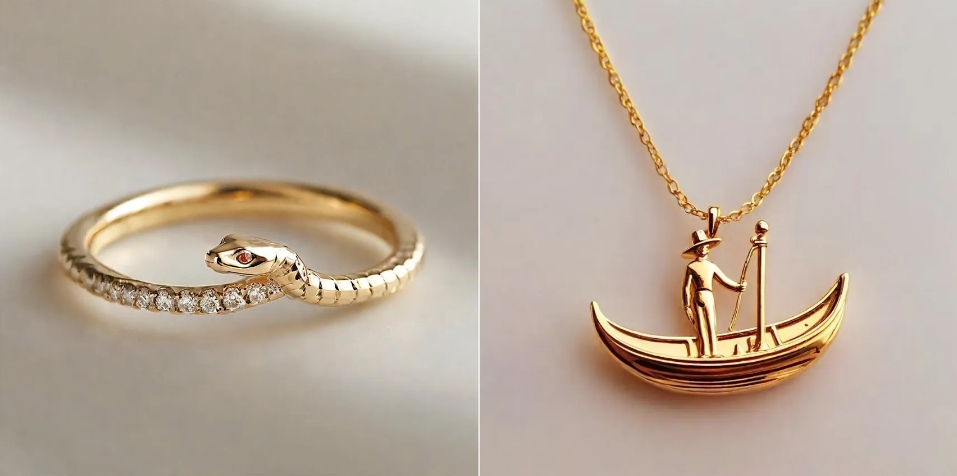
Generally, Naficy said Arcade is trying to price its products to compete with other custom jewelry makers and other mid-tier online brands. For example, a simple Venetian gondola gold-plated pendant necklace costs $132, while a gold-plated pendant and chain from jewelry brand Mejuri costs $216; while a more complex 14K gold ring with lab-grown diamonds costs $268, while a similar design of the same material from an Etsy seller costs $640.
There is a question of how much shoppers are willing to spend on discretionary items, especially as they feel the pinch of inflation and become more selective about what they buy. That has hurt other companies, such as Etsy, where sales have stagnated over the past few years as shoppers cut back on extravagant purchases or shifted spending to other categories.
Hoffman doesn’t seem to have any qualms. While he’s one of the most prominent evangelists about how artificial intelligence will impact the world, he said Naficy stood out among the founders he’s met because he takes a different tack.
"In AI, most people are moving in the same direction for a lot of things," Hoffman said, with a hint of sarcasm. "Arcade is the only thing I see that is going in a different direction and is broadly meaningful and industry-changing."
Naficy personally recruited the first artisans and manufacturers signed on to produce Arcade jewelry, and spent the past 18 months working with them to test early versions of the product.
Initially, she worried that artisans would be reluctant to work with Arcade because of its reliance on AI. As a test, she sent a Moroccan artist an AI-generated image of a piece of jewelry she wanted him to make. When she received the finished product, she confessed the origins of the design to him over a WhatsApp video call. She asked him if he had heard of AI, bracing herself for possible confusion — or worse, anger.
"The camera turns around and there's his son, almost 30 years younger. He says, 'Of course we've heard of AI. We use AI to write all our captions on Instagram,'" she said.
So far, the Moroccan designer’s reaction roughly mirrors how receptive the technology has been to the artists the company has approached. “They see it as a way to help them build their business, get more orders, understand people’s needs better and actually have more custom business,” Nafisi said.
Concerns about AI replacing artists and accelerating the creation of knockoffs of photographs, books and designs have sparked panic in many creative fields. Companies like OpenAI are fending off lawsuits from authors and media companies that they say are using their work without permission to train AI models.
While Arcade transfers some of the creative freedom of jewelry makers to its AI-enabled customers, Naficy said the site has taken steps to prevent obvious design theft. Arcade’s AI models have controls built into them to prevent shoppers from requesting trademarked or copyrighted terms. For example, the site would decline to fulfill a request for a necklace with the Chanel double-C logo or a Harry Winston-style engagement ring.
While Arcade allows users to upload photos of existing jewelry pieces to model their designs, Naficy said they cannot use this feature to create exact replicas. Arcade designs its models to make substantial changes to the products produced based on these photos.
Naficy said she thinks Arcade has an advantage over its competitors in combating would-be copycats because Arcade shoppers don’t have full control over the designs its technology generates. “Whereas I guess you can go into Etsy and send a picture of an item to a designer on Etsy and there’s no filter that’s going to change that design, right?”
An Etsy spokesperson pointed to the marketplace’s policies, which prohibit unauthorized copies or imitations of items, as well as counterfeit goods.
In addition to signing up Moroccan jewelry manufacturers, Naficy has also invited artisans from countries such as India, Italy, Thailand and the United States to join the platform. Naficy would not disclose the exact number of artisans currently registered to use Arcade, but she said that matching the number of artisans with user demand is a key part of the launch, and Arcade will add more artisans as demand grows. The company has also signed up larger factories and manufacturers that can manage large-scale production of popular products.
Relationships with manufacturers will also help Arcade if it strikes a deal with a big-name retailer to use its technology to let customers design custom products, something Naficy hopes to see happen soon.
Some aspects of the Arcade system still need fine-tuning.
When shoppers arrive at the site’s homepage, which is adorned with an arch animation reminiscent of the shopping arcades of Paris and Milan, the inspiration for the company’s name, they’re greeted by a design dynamic generated by past arcade customers.
Shoppers can use these designs as a starting point to create new variations through Arcade’s AI editing tools. (Customers can actually earn money from Arcade if other customers find their designs inspiring and buy them. The amount can range from 2.5% of the item’s retail price to a higher percentage, depending on how often the user sells or if they choose to raise the price of their design.) Or, they can create an entirely new design from scratch with their own prompts.
During her first demo of the site, Naficy tried to create a new design for me by entering the prompt “ring with bird,” but Arcade generated several elephant-themed designs instead.
The error may have been caused by Naficy accidentally submitting the hint that Arcade suggested in its design tool. Naficy adjusted the hint on his second attempt to correctly generate a design that included the bird.
Because we didn't specify the metal of the ring, gold was selected by default. Next, Naficy specified that she wanted a more colorful enamel ring, which generated a 2D image of an enamel ring with a vivid blue bird pendant. We further edited the image, changing the color of the bird's wings to red using a tool similar to Microsoft Paint.
As more people use Arcade, the company says it will get better at translating users’ cues into designs, in part because shoppers and Arcade employees will rate the generated images and its models will adjust based on the feedback.
Naficy aims to expand Arcade relatively quickly, both by adding artisans who can work with a wider range of materials and by expanding into other potential categories, such as home goods. She also hopes that as more consumers become accustomed to using AI, prompting Arcade to create a custom product will be as easy as doing a Google search.
“If we’re good enough, one day we could partially replace search in the sense that you don’t have to spend time looking through page after page of results for your ‘circular purple rug that’s three feet in diameter,’ ” she said.
“You can actually just type it in and magically, it appears.”
In view of the actual needs and development trends of the jewelry industry in the application of artificial intelligence (AI), the following strategic suggestions are put forward:
First of all, jewelry companies should actively embrace artificial intelligence technology, strengthen technology research and development and talent training, and enhance the core competitiveness of the company. Through cooperation with universities, research institutions, etc., we can jointly promote the application and development of artificial intelligence technology in the jewelry industry.
Secondly, jewelry companies should make full use of the data analysis capabilities of artificial intelligence technology to deeply explore consumer needs and market trends and formulate precise marketing strategies. At the same time, through personalized recommendations and virtual try-on functions, they can improve consumers' shopping experience and satisfaction.
Finally, jewelry companies should also pay attention to the latest progress and application cases of artificial intelligence technology in other fields, and continuously expand the application scope and innovation space of artificial intelligence in the jewelry industry. Through cross-border cooperation and resource integration with other industries, jointly promote the transformation, upgrading and sustainable development of the jewelry industry.
In summary, the application of artificial intelligence in the jewelry industry has broad prospects and far-reaching significance. Jewelry companies should actively seize this historical opportunity, make full use of the advantages of artificial intelligence technology, promote the innovation and development of the jewelry industry, and bring consumers a better jewelry experience.