

In 2024, how can jewelry retailers play the big game of digitalization well?
In recent years, with the gradual weakening of traffic dividends and the continuous increase in traffic costs, a new efficiency competition has been launched in the e-commerce field.
Shelf e-commerce, represented by Taobao, is constantly strengthening its content strategy; content e-commerce, represented by Douyin, emphasizes the importance of shopping malls and search scenarios, and gradually deepens the integration of multiple scenarios such as live broadcasts, short videos, searches, and shelves.
At the same time, e-commerce platforms are also accelerating their integration with offline entities such as local retail to encourage more jewelry companies to implement full-domain operations.
Shelf e-commerce, represented by Taobao, is constantly strengthening its content strategy; content e-commerce, represented by Douyin, emphasizes the importance of shopping malls and search scenarios, and gradually deepens the integration of multiple scenarios such as live broadcasts, short videos, searches, and shelves.
At the same time, e-commerce platforms are also accelerating their integration with offline entities such as local retail to encourage more jewelry companies to implement full-domain operations.
These signs indicate that a new era of digital retail has arrived, which requires jewelry brands to have a mindset of global operations and refined operations. Jewelry brands should shift their focus from pursuing traffic to users themselves, and from pursuing scale and expansion to focusing on closed loops and efficiency.
Today, let’s talk about the digital growth model and future development trends of the jewelry retail industry.
Retail digitization
Become the anchor point for global performance growth
In the era of inventory, retail digitalization has become the anchor point for overall performance growth. In this process, offline jewelry stores have once again emerged as an important growth engine for the retail industry. This phenomenon is due to consumers' demand for quick response, instant satisfaction and shopping experience, which has also promoted the digitalization process of the jewelry retail industry.
As digitalization advances, offline stores must re-examine their roles and functions to achieve performance growth. This can be achieved through organic integration with online channels. In this process, offline stores can play a variety of roles, including display and experience centers, providing customers with on-site shopping opportunities, and serving as logistics and distribution centers to ensure timely delivery. By giving full play to these functions, offline stores can continue to contribute to the growth of the retail industry in the digital age.
For example, Chow Tai Fook. As a leading enterprise in the jewelry industry, Chow Tai Fook has made remarkable achievements in digital transformation and has become a leader in the industry. Its automatic logistics and distribution center in Shunde is the first in the world to realize the automatic distribution of jewelry. These advanced technologies and concepts provide valuable experience and inspiration for the digital transformation and intelligent upgrading of the jewelry industry.
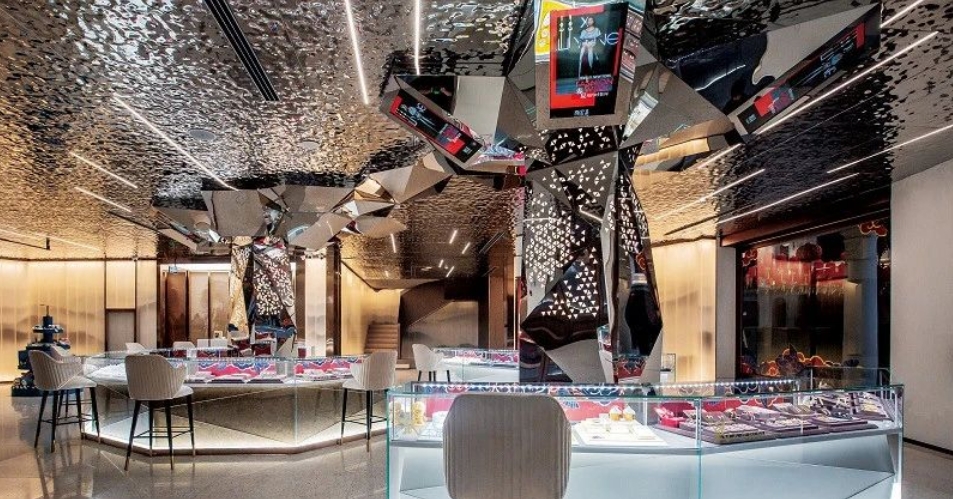
Nowadays, Chow Tai Fook's offline stores not only have traditional jewelry displays, but also "cloud counters" connect physical store orders to e-commerce platforms, which not only clearly show the information such as product craftsmanship, stories, prices, etc., but also display more products. Chow Tai Fook itself has accumulated 9 million corporate WeChat customers and over 10,000 customer groups, and the repurchase rate of brand members is as high as 50%. Such a global, multi-touchpoint private domain system can not only improve the user's global experience, but also achieve excellent retention and conversion effects.

Chow Tai Fook Smart Retail Offline Stores
The omnichannel model has become
The operational base of the jewelry retail industry
In today's jewelry retail industry, the omni-channel model is increasingly becoming the key foundation for its operations. This model is a strategy adopted by retailers in the pursuit of global growth, aiming to achieve traffic sharing, commodity sharing, and profit sharing, thereby maximizing the effective use of resources. The development of the omni-channel model in the retail field not only allows retailers to operate more efficiently, but also brings them more business opportunities. In the following, we will explore the importance of the omni-channel model and how it is changing the retail industry.
The core goal of the omni-channel model is to integrate online and offline channels into an efficient and organic whole. This integration not only saves costs, but also provides more sales and service opportunities. Through the omni-channel model, retailers can achieve greater business with less cost because they can make the most of their own resources.
For example, Chow Tai Fook. The brand's omni-channel strategic model has always been to connect online and offline, with the goal of empowering offline with online. The first important deployment made by Chow Tai Fook was to return sales performance completely to specific physical stores. Second, for all online transactions, users will eventually return to a shopping guide in a physical store to undertake and manage. In this way, not only will the performance of the shopping guides not be affected, but it will also promote the increase of their performance to a certain extent; third, marketing resources are allocated and undertaken by the headquarters, and sincerity is shown to help them attract traffic.

Chaohongji's new retail model is the innovative model of "one store and one cloud store", which realizes all-weather and all-region sales, while breaking the physical limitations of offline store inventory and realizing inventory sharing among different stores. It not only allows customers to have more choices and fully improves the user's omni-channel shopping experience, but also optimizes inventory and improves inventory turnover efficiency. Ten thousand online stores + community conversion + mini program mall retention + guidance to online, projected in the private domain is community + mini program + live broadcast.
Through the innovative model of "one store and one cloud store", Chaohongji's retail platform brings traffic and data sharing to dealers. In terms of logistics, customers can make offline purchases and ship online; they can pay online and pick up goods at offline stores; and goods in one city can be shipped to multiple cities.
In addition, the interaction of "social group traffic diversion + video account live broadcast" is used as the baseline to convert offline purchasing power to online. Through the three steps of pre-broadcast reservation, broadcast reminder, and broadcast traffic diversion, Chaohongji's live broadcast achieves both water diversion and water storage: broadcast reservation and reminder reduce the loss of target users, and broadcast traffic diversion greatly plays the advantages of social platforms, constantly brings new high-potential users to the live broadcast room, expands the viewing volume of accurate users, and improves transaction potential.
During the live broadcast, social fission gameplay is introduced to allow participants to become communicators, allowing the communication effect to continue to ferment, further promoting the retention and conversion of new and old members, and realizing fission-like communication from public domain to private domain and from private domain to private domain.
Judging from the current trend, the omni-channel model will become the long-term development trend of the future retail industry. As consumer demands continue to change, retailers need to be more flexible to meet their expectations. Integrating the advantages of online and offline not only provides more sales channels, but also creates more opportunities for interaction and experience. Consumers can browse products online and then try them on in person in physical stores, or vice versa. This seamless shopping experience will become a key factor in the success of the future retail industry.
Global growth needs to be achieved
Traffic sharing, product sharing and profit sharing
To achieve omni-regional growth, that is, to achieve comprehensive and all-round growth in the retail sector, it is necessary to establish a closely coordinated ecosystem, including traffic sharing, commodity sharing and profit sharing. This ecosystem will build a fast-response retail organism designed to meet the ever-changing market needs and consumer expectations.
The retail organism will develop into an entity that integrates various elements, from the development of dealers to dealer collaboration, to the improvement of omni-channel fulfillment efficiency and the reshaping of the value chain, and the establishment of a new symbiotic relationship between brands and dealers. The ultimate goal is to build a highly responsive and efficient retail organism that operates based on the entire domain and all scenarios, maximizes the value of data assets, and becomes the support and driving force for hundreds of billions of brands.
One of the key elements is omni-channel and omni-scenario operation, which means that the retail organism must operate in different channels and scenarios to meet the needs of various types of consumers. This may include online and offline sales, social media, logistics and supply chain management. Data asset value creation is another key component, which refers to the effective management, analysis and use of data to improve the quality of decision-making and business insights. The information department plays a vital role in achieving omni-channel growth because they need to coordinate various departments and ensure the flow of data and information to support strategic decisions and the realization of growth goals.

This view is applied to the jewelry industry. The jewelry retail industry must invest more resources in digital construction and information technology to establish scientific management, risk control, investment evaluation and other systems. This will help support the smooth operation of the omni-channel model and the continuous development of the retail organism. The continuous innovation and development of digital technology means that the jewelry retail industry must constantly adapt to new technologies and trends to meet the evolving market needs. In addition, risk control and investment evaluation are also crucial to ensure the effective allocation of resources and sustainable growth of the business.
In the future, we expect to see more and more jewelry brands fully grasp the growth opportunities in the digital retail sector through comprehensive and sophisticated strategic planning.
Source of some opinions: 2023 Retail Digital Growth Practice Report