

Bain's latest report: Jewelry sales will reach 29 billion euros in 2023, still the fastest growing luxury category
Recently, Bain & Company, a global market consulting firm, and the Italian Association of Luxury Goods Manufacturers jointly released the 22nd edition of the luxury goods market research report "Luxury Evergreen: Gathering Strength and Expanding in Turbulence".
The luxury goods sectors tracked in this report include personal luxury goods and high-end experiences, and are divided into nine market segments, among which the personal luxury goods sector includes jewelry, accessories, watches, leather goods, clothing, etc.
The luxury goods sectors tracked in this report include personal luxury goods and high-end experiences, and are divided into nine market segments, among which the personal luxury goods sector includes jewelry, accessories, watches, leather goods, clothing, etc.
The report points out that by 2030, four trends will profoundly reshape the future luxury market:
1/ Chinese consumers will resume their pre-pandemic dominance in luxury purchases, and their (global) luxury consumption share will grow to 35% to 40% of the world.
2/ The Chinese mainland market will surpass the American and European markets to become the world's largest luxury market, with its share increasing to 24% to 26%.
3/ The younger generation (Generation Y, Z and Alpha) will become the largest luxury consumer group, accounting for nearly 85% of global consumption.
4/ Single-brand stores and online will become the main channels for luxury purchases, and are expected to account for 60% to 66% of the market share.
Luxury Goods Industry Overview
The report said that 2023 will be a turbulent year for the luxury industry. After two years of excellent recovery with double-digit growth after the epidemic, the industry's quarterly growth rate has gradually slowed down to the low single digits. In this environment, profits will also be under slight pressure.
Considering that profit levels in 2021 and 2022 returned to an average of 21% after the epidemic, the report predicts that profit margins in 2023 will be between 19% and 22%.
Although the industry continues to benefit from price increases and a shift to higher-margin direct channels, profit levels also reflect increased marketing spending by luxury brands, as well as rising labor costs and energy prices.
Considering that profit levels in 2021 and 2022 returned to an average of 21% after the epidemic, the report predicts that profit margins in 2023 will be between 19% and 22%.
Although the industry continues to benefit from price increases and a shift to higher-margin direct channels, profit levels also reflect increased marketing spending by luxury brands, as well as rising labor costs and energy prices.
However, the overall size of the global luxury market will still reach 1.51 trillion euros in 2023, a strong increase of 8% to 10% over 2022 at current exchange rates, setting a new high in the value of the global luxury market and proving its resilience. At the same time,
all luxury market segments have achieved growth and finally narrowed the gap with pre-epidemic levels (including the luxury hotel sector, which has rebounded the slowest). Since 2019, the Americas and Asia have been the two main sources of growth in global luxury consumption.
all luxury market segments have achieved growth and finally narrowed the gap with pre-epidemic levels (including the luxury hotel sector, which has rebounded the slowest). Since 2019, the Americas and Asia have been the two main sources of growth in global luxury consumption.
Among them, the continued growth of the personal luxury goods market, including jewelry, accessories, watches, leather goods, clothing, etc., is the "core of the core" of the luxury goods market segment and the focus of the report's analysis.
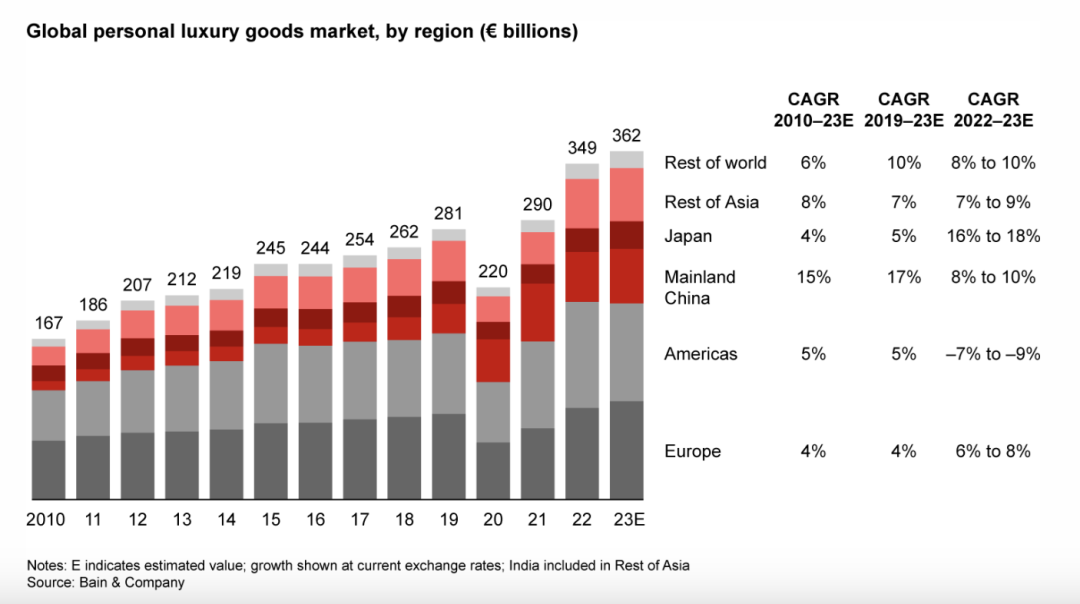
It is expected to reach 362 billion euros in 2023, a 4% increase from 2022 at the current exchange rate.
However, the market performance has weakened quarter by quarter, and uncertainty still exists in the fourth quarter. Unlike the slowdown signals in the US and European markets, the Chinese market has re-accelerated growth.
It is expected to reach 362 billion euros in 2023, a 4% increase from 2022 at the current exchange rate.
However, the market performance has weakened quarter by quarter, and uncertainty still exists in the fourth quarter. Unlike the slowdown signals in the US and European markets, the Chinese market has re-accelerated growth.
This overall slowdown has also led to an increase in the polarization of brand performance.
The report predicts that in 2023, only about two-thirds of brands will achieve growth, compared with 95% in 2022. However, due to inflationary pressures and the balancing force between continued investment and continued price increases in the future, average profitability has stabilized.
The report predicts that in 2023, only about two-thirds of brands will achieve growth, compared with 95% in 2022. However, due to inflationary pressures and the balancing force between continued investment and continued price increases in the future, average profitability has stabilized.
Despite this, brands continue to invest in modernizing operations and infrastructure to support future growth. Specifically, these brands are investing in more robust information technology and data infrastructure to support the industry's continued digitalization, while also renovating their store networks.
In turbulent times, successful brands often demonstrate a strong commitment to future investment: they outperform other brands through superior investments in brand visibility (spending an average of 20% more on marketing than other brands), general infrastructure (investing 20% more in capital expenditures), and organizational strengthening (employee headcount growth 30% more than other brands).
In turbulent times, successful brands often demonstrate a strong commitment to future investment: they outperform other brands through superior investments in brand visibility (spending an average of 20% more on marketing than other brands), general infrastructure (investing 20% more in capital expenditures), and organizational strengthening (employee headcount growth 30% more than other brands).
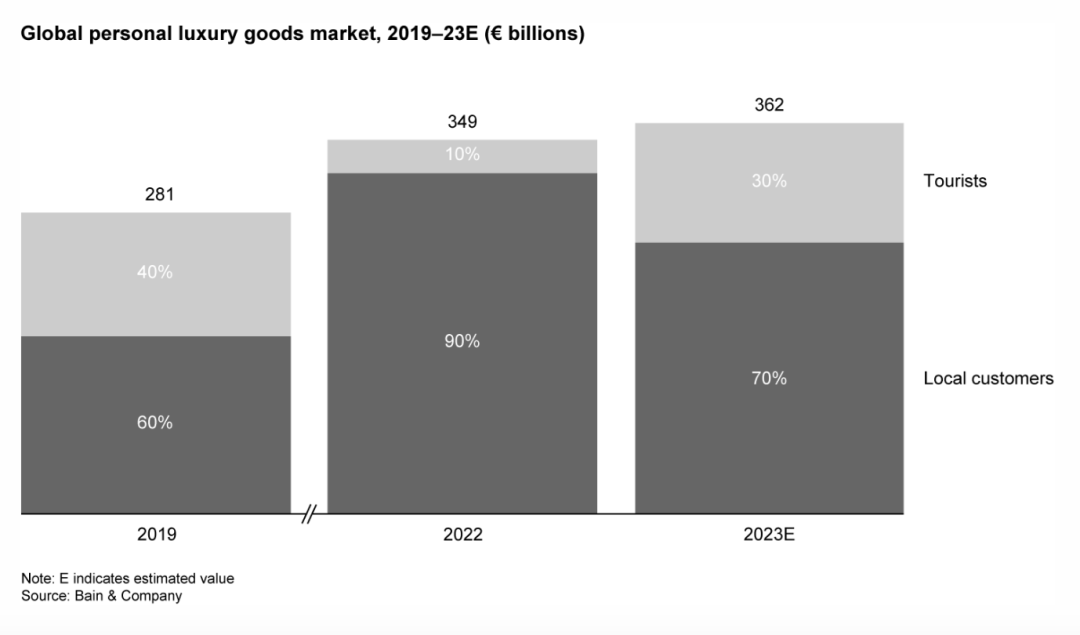
The report also pointed out that at present, with the lifting of the epidemic blockade at the end of 2022, the borders will reopen and the tourism industry will regain vitality.
In absolute terms, tourists' spending on luxury goods has almost returned to pre-epidemic levels, but their share is only 30% of global luxury purchases, compared with 40% in 2019, and there is still potential for growth, or it can return to the pre-epidemic share.
In absolute terms, tourists' spending on luxury goods has almost returned to pre-epidemic levels, but their share is only 30% of global luxury purchases, compared with 40% in 2019, and there is still potential for growth, or it can return to the pre-epidemic share.
Chinese mainland market
Personal luxury goods sales ranked third
Overall, the Asian market leads the growth pace of the luxury market in 2023 due to strong domestic demand and the re-influx of Chinese tourists. Among them, the prosperity of the Japanese market is due to local customers and the weak yen exchange rate that is conducive to the influx of tourists; the Chinese mainland market performed strongly after reopening in the first quarter, but gradually slowed down with a new round of macroeconomic concerns;
the Southeast Asian countries market has generated positive momentum due to strong regional tourism and growing interest from local consumers (especially Thailand); however, 2023 is a challenging year for the Korean market, with unfavorable macroeconomic headwinds slowing local consumption, and strong currency exchange rates causing domestic and international tourists to go shopping in other international destination markets.
the Southeast Asian countries market has generated positive momentum due to strong regional tourism and growing interest from local consumers (especially Thailand); however, 2023 is a challenging year for the Korean market, with unfavorable macroeconomic headwinds slowing local consumption, and strong currency exchange rates causing domestic and international tourists to go shopping in other international destination markets.
In addition, the European market continues to benefit from the gradual recovery of tourism, stimulating growth in all national markets, among which holiday resorts and major luxury cities are particularly attractive to high-spending groups.
Even if macroeconomic instability affects local aspirational consumers (aspirational customers, referring to consumers who limit their spending to the lower end of the price range but expect to buy higher-priced goods), the top customer base still maintains a positive momentum to drive market growth.
Even if macroeconomic instability affects local aspirational consumers (aspirational customers, referring to consumers who limit their spending to the lower end of the price range but expect to buy higher-priced goods), the top customer base still maintains a positive momentum to drive market growth.
Meanwhile, the Americas slowed for the full year, down 8% from 2022, as widespread uncertainty dampened spending by “aspirational consumers.” While the top customer segments remained positive, they began to shift spending overseas, favoring consumption abroad, due to a favorable dollar-euro exchange rate and attractive price differentials.
Elsewhere in the world, Saudi Arabia is accelerating, attracting investment from major luxury brands, while Australia also offers fertile ground for growth.

Focusing on the field of personal luxury goods, including jewelry, accessories, watches, leather goods, clothing, etc. in 2023, the global regional rankings changed.
The European market regained the top spot in sales, the American market slowed down and ranked second, and the Chinese mainland market ranked third.
The European market regained the top spot in sales, the American market slowed down and ranked second, and the Chinese mainland market ranked third.
Among them, the European market has strong consumption, with sales reaching 102 billion euros in 2023. Although local customers' purchases slowed down throughout the year due to macroeconomic uncertainties, all markets performed well. VIC customers and tourists maintained a positive momentum.
The report's analysis of Global Blue's duty-free spending data showed that between 2019 and 2023, spending by American tourists in Europe increased 2.5 times, while tourists from the Middle East increased 1.7 times during the same period.
However, spending by Chinese tourists has not yet recovered and is only about 40% of the 2019 level. Overall, as the number of shoppers and purchases both declined, European tourists' spending on luxury goods increased by 50% compared to 2022, entirely due to the support of rising pricing.
The report's analysis of Global Blue's duty-free spending data showed that between 2019 and 2023, spending by American tourists in Europe increased 2.5 times, while tourists from the Middle East increased 1.7 times during the same period.
However, spending by Chinese tourists has not yet recovered and is only about 40% of the 2019 level. Overall, as the number of shoppers and purchases both declined, European tourists' spending on luxury goods increased by 50% compared to 2022, entirely due to the support of rising pricing.
Sales of personal luxury goods in the Americas are expected to reach €101 billion, down 8% from 2022. The market slowed throughout the year, with "aspirational consumers" putting the brakes on luxury purchases. However, top customers remained resilient, partially redirecting their spending overseas and towards luxury areas other than products.
Most Latin American countries were affected, with the exception of Mexico.
Most Latin American countries were affected, with the exception of Mexico.
The mainland China market exceeds the 2022 level with a sales growth rate of 9% at current exchange rates, reaching about 58 billion euros. In 2023, the market started strongly, but gradually slowed down as macroeconomic concerns emerged.
However, the economic stimulus in the third quarter may have stimulated the growth of local consumption and encouraged new investment in first-tier cities. The report also said that Hainan is expected to become a "dazzling luxury center" as the Chinese government plans to make Hainan "zero tariff on the entire island" by 2025.
However, the economic stimulus in the third quarter may have stimulated the growth of local consumption and encouraged new investment in first-tier cities. The report also said that Hainan is expected to become a "dazzling luxury center" as the Chinese government plans to make Hainan "zero tariff on the entire island" by 2025.
Sales in the Asian market (excluding mainland China and Japan) increased by 8% in 2023. Southeast Asian countries showed positive market momentum due to a growing local customer base, good tourism traffic and foreign investment, with Thailand leading the way in growth.
China's Hong Kong and Macau markets resumed prosperity in the first half of 2023, but slowed down in the second half due to weak tourist inflows. Due to unfavorable macroeconomics and the impact of a strong currency, tourists flocked to other international destinations, resulting in a slowdown in local consumption in South Korea, which, however, remained the main impact market in the region.
China's Hong Kong and Macau markets resumed prosperity in the first half of 2023, but slowed down in the second half due to weak tourist inflows. Due to unfavorable macroeconomics and the impact of a strong currency, tourists flocked to other international destinations, resulting in a slowdown in local consumption in South Korea, which, however, remained the main impact market in the region.
Japan is the fastest growing market, growing 17% at current exchange rates, reaching sales of €29 billion in 2023. This growth is due to the renewed energy and interest of local consumers and the weak yen, which attracts tourist inflows throughout the year (especially from China).
In addition, the report notes that some brands have also established exclusive partnerships with local Japanese crafts and creatives to enhance their cultural relevance and bring brands closer to local culture.
In addition, the report notes that some brands have also established exclusive partnerships with local Japanese crafts and creatives to enhance their cultural relevance and bring brands closer to local culture.
The rest of the world grew by 9% to €17 billion at current exchange rates. The Middle East market showed strong growth across the board, but the sudden shock of the war has brought uncertainty to the development in the coming months. Dubai remains an important regional center.
The Saudi Arabian market is accelerating and still has huge untapped potential, attracting investment from major luxury brands. In addition, Australia is becoming a fertile ground for growth, and local brands are beginning to attract the interest of luxury consumers.
The Saudi Arabian market is accelerating and still has huge untapped potential, attracting investment from major luxury brands. In addition, Australia is becoming a fertile ground for growth, and local brands are beginning to attract the interest of luxury consumers.
Jewelry is the fastest growing personal luxury goods category by 2023
Focusing on the personal luxury goods market, "the core of the entire luxury industry", all personal luxury goods categories have grown due to continued price increases, but the growth rate is lower than in the past two years.
At the same time, for the first time in a decade, the price increase has also partially weakened sales. Calculated at the current exchange rate, the overall growth rate is about 4%, and sales will set a new record in 2023, expected to reach 362 billion euros.
Among them, by category, jewelry is the fastest growing category, with a growth rate of 6% in 2022.
At the same time, for the first time in a decade, the price increase has also partially weakened sales. Calculated at the current exchange rate, the overall growth rate is about 4%, and sales will set a new record in 2023, expected to reach 362 billion euros.
Among them, by category, jewelry is the fastest growing category, with a growth rate of 6% in 2022.
Driven by the investment mentality, the sales of jewelry and accessories categories in 2023 are expected to be about 30 billion euros. Among them, jewelry sales in 2023 will be about 29 billion euros, an increase of 5% to 6% over 2022.In the case of macro uncertainty, high-end jewelry is undoubtedly a bright spot for investment.
In addition, consumer demand for customized jewelry continues to grow, while the super-rich group is increasingly interested in repurchasing high-end jewelry.
The fashion jewelry sub-category also continues to accelerate, as do the genderless and men's jewelry sub-categories.
In addition, consumer demand for customized jewelry continues to grow, while the super-rich group is increasingly interested in repurchasing high-end jewelry.
The fashion jewelry sub-category also continues to accelerate, as do the genderless and men's jewelry sub-categories.
In addition, despite the increasing polarization of the industry, the watch category continues to thrive. Sales of new watches increased by 3% to 4% to a record 55 billion euros. Both high-end and entry-level products performed well, while mid-range products performed weakly.
In addition to watch giants, small DTC brands with innovative value propositions are also attracting collectors, and Generation Z continues to show strong interest in the watch category.
In addition to watch giants, small DTC brands with innovative value propositions are also attracting collectors, and Generation Z continues to show strong interest in the watch category.
In addition, accessories remain one of the largest personal luxury goods categories, growing by 2% to 4%. The report also estimates that sales in the personal luxury goods industry in the fourth quarter of 2023 may remain flat compared to the last quarter of 2022, and drastic changes are unlikely.
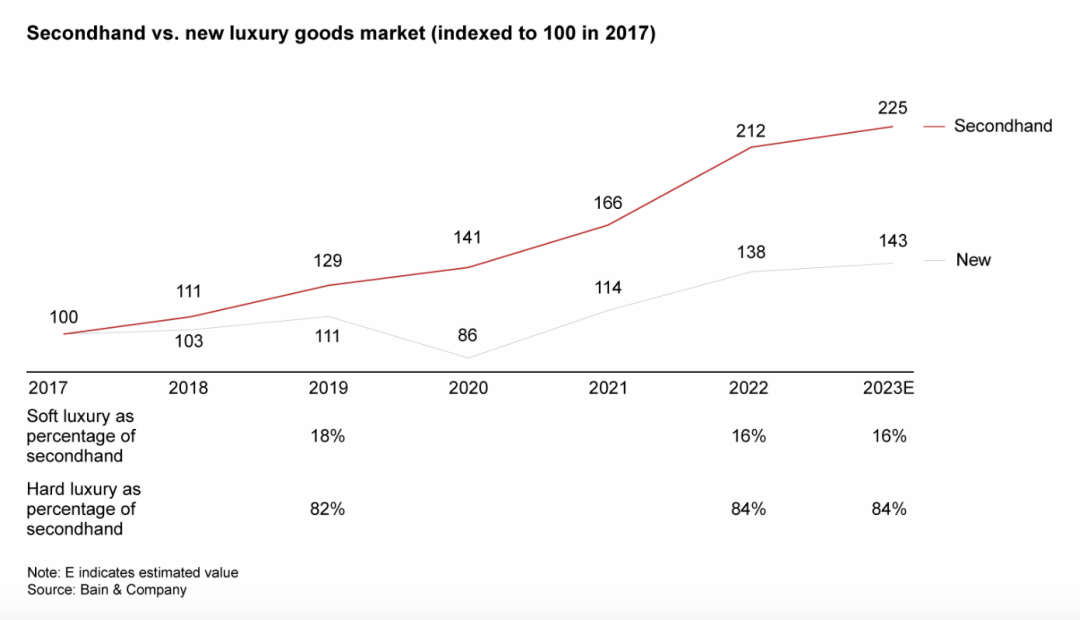
Europe is still the largest market for second-hand luxury goods; hard luxury accounts for 80%
The report also tracks the dynamics of the second-hand luxury goods market, which will increase to 45 billion euros in 2023, with sales growth slowing by 4% to 6%, in line with the 4% increase in luxury goods - confirming the trend observed last year that the second-hand luxury goods market is gradually returning to normal.
By market, Europe is still the largest market, accounting for about 45% to 50% of global second-hand luxury goods sales; the US market follows closely, and its consumers are increasingly interested in timeless second-hand bags. By category, hard luxury goods (including watches and jewelry) still account for more than 80% of the total market.
The report concluded that while brands continue to raise prices and general macroeconomic challenges remain, the second-hand market will increasingly become an important entry point for younger generations and "aspirational consumers."
Four trends will reshape the luxury market by 2030
Looking ahead to 2024, the report said that considering the growth in tourism spending, the recovery of the US market, the acceleration of the Chinese market, and the return to normal in the Middle East and Japan, the personal luxury goods market will show a moderate growth trend in 2024, and in the most realistic scenario, full-year sales are expected to increase by 1% to 4%.
However, in a more positive scenario, the United States will accelerate its recovery, and the improvement in consumer confidence levels will drive local demand in various markets, and personal luxury goods market sales in 2024 may also increase by 5% to 7%.
However, in a more positive scenario, the United States will accelerate its recovery, and the improvement in consumer confidence levels will drive local demand in various markets, and personal luxury goods market sales in 2024 may also increase by 5% to 7%.
Looking ahead to 2030, despite the potential difficulties, solid fundamentals will continue to drive market growth, and the report predicts that overall luxury consumption will achieve a healthy annual growth of 4% to 8%, from the current estimated 1.5 trillion euros to 2.5 trillion euros in 2030.
Focusing on the personal luxury goods industry, the report predicts that by 2030, solid market fundamentals will push the annual growth rate of the personal luxury goods market to 5% to 7%, and the market value of personal luxury goods will rise to 540 billion euros to 580 billion euros.
This will be twice the market value in 2019 (when the market value was approximately 281 billion euros).
Focusing on the personal luxury goods industry, the report predicts that by 2030, solid market fundamentals will push the annual growth rate of the personal luxury goods market to 5% to 7%, and the market value of personal luxury goods will rise to 540 billion euros to 580 billion euros.
This will be twice the market value in 2019 (when the market value was approximately 281 billion euros).
The report suggests that in an increasingly crowded market, brands must focus on creativity and innovation to enhance their relevance to consumers, with the ultimate goal of cultivating brand followers while expanding their customer base.
At the same time, in a period of slowing growth, brands also need to pay attention to profit levels and control costs across the value chain, which can be achieved through initiatives including artificial intelligence, stricter inventory management, and cost control to improve the accuracy of business planning and demand forecasting.
At the same time, in a period of slowing growth, brands also need to pay attention to profit levels and control costs across the value chain, which can be achieved through initiatives including artificial intelligence, stricter inventory management, and cost control to improve the accuracy of business planning and demand forecasting.
In addition, the report said that practitioners should also look forward to a new round of investment and merger season. This is born out of the necessity to solve key challenges in the industry, such as supporting category growth, expanding in new geographic areas, or ensuring control of key resources or expertise.
At the same time, leadership in sustainability and technology, as well as the active adoption of technology, will continue to exist as key factors, such as redesigning the supply chain structure to achieve higher transparency, better agility and resilience, and a lower carbon footprint.
At the same time, leadership in sustainability and technology, as well as the active adoption of technology, will continue to exist as key factors, such as redesigning the supply chain structure to achieve higher transparency, better agility and resilience, and a lower carbon footprint.

Source: Bain & Company official websit